

Seeds of change: Parami students’ journey through Japan and Dwight Clark’s legacy
Updated: Jul 22
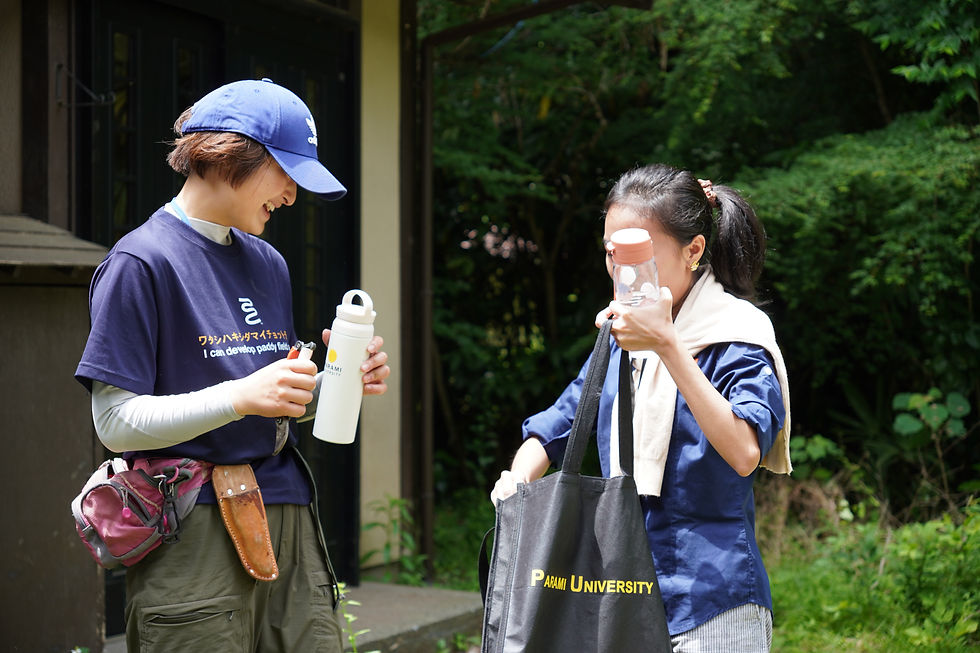
Long after returning home, the sounds of Tokyo still linger for 12 Parami University undergraduate students—the rush of train stations, quiet gardens tucked between skyscrapers, and laughter shared during moments of discovery across two transformative weeks in Japan. Their journey, part of the Dwight Clark Cross-Cultural Program, took place from May 24 to June 5, 2026, as Tokyo shifted from late spring into the early rainy season. Between warm days, rising humidity, and occasional heavy rain, the changing weather became part of an experience that felt both fleeting and deeply lasting.
Arrival in Tokyo: First Impressions
The students’ first impressions of Tokyo were shaped by its blend of urban life and natural beauty, as well as the warmth and hospitality they experienced throughout their stay.
Su Lae Phyu reflected on Tokyo’s train station announcements, saying, “The melodies made me feel welcomed, as if gently saying, ‘You’re on your way to your destination,’ giving me a sense of hope and certainty.”
For Nyein Min Soe, the experience initially felt surreal: “On my first day in Japan, it still felt like I was at the learning hub… It took a while for it to sink in that I was actually in Tokyo.”
Despite being their first time in Japan, the students described the city as clean, vibrant, and surprisingly familiar, where everyday routines and the kindness of people made Tokyo feel less like a foreign place and more like a space that gently welcomed them.
A Space to Feel Seen, Heard, and Supported
Students spent their first full day at International Christian University (ICU) in Tokyo, where they were warmly welcomed by university leaders and later joined ICU students for a sushi dinner, marking the beginning of new friendships and cross-cultural connections.
From the beginning of the program, organizers from International Christian University (ICU), JICUF Foundation (JICUF), and Volunteers in Asia (VIA), along with community members from Parami University, were consistently warm and supportive. Students felt their perspectives were valued and their participation encouraged throughout lectures, discussions, and meetings with Japanese students and partners.
For Aye Thiri Phyo, one of the most meaningful takeaways was the profound sense of safety and belonging she experienced. “I really felt that they valued our presence throughout the program,” she said. The feeling reminded her of the Japanese concept of ibasho, which they learned about throughout the program—“a place where one belongs.” Feeling welcomed in that way gave her the confidence to speak up, engage more deeply in discussions, and make the most of every learning opportunity.
Their engagement was warmly received, with program leaders often expressing admiration for their enthusiasm and passion for learning. Kazutoh Ishida, Executive Director at VIA, offered one of the highest compliments they could receive: “This year’s group was among the strongest I’ve worked with.”
The program offered a multidimensional learning experience that combined academic study, cultural immersion, and professional exposure. At ICU, students joined lectures and discussions on topics such as global citizenship, reconciliation, political ethics, and global change. They also visited organizations and institutions, including B-Lab, the Japan Myanmar Culture Center, Comachiplus, the Japan Association for Refugees, Tokyo Rainbow Pride, the U.S. Embassy in Tokyo, Gojo & Company, and Uzabase.
Students described the program as a thoughtful blend of learning, reflection, and enjoyment. The first week at International Christian University (ICU) focused on lectures and workshops that encouraged reflection and deeper understanding, while the second week emphasized experiential visits and cultural immersion. Through conversations with faculty, NGO leaders, diplomats, and entrepreneurs, students explored key issues and shared perspectives from Myanmar.
“I really loved how we spent the first week having lots of discussions, and then went out in the second week to observe different communities and meet a variety of people,” said Su Lae.
Where Inspiration Shapes Aspiration
Students recalled a memorable session, “My Life for What? Exploring Values, Responsibility, and Global Citizenship,” led by Paul Hastings at ICU, which prompted deep reflection on their roles in both local and global communities. The discussion resonated with Parami University’s emphasis on responsibility and civic engagement, encouraging students to see themselves as agents of change. For Aye Thiri, this connection was especially meaningful. “I applied to Parami University not just for a degree, but for its strong focus on civic engagement.”
Another recurring theme throughout the program was “hope,” which emerged across lectures, field trips, conversations with ICU students, and everyday interactions. Students reflected on how hope shapes their learning, their communities, and their sense of purpose moving forward.
For Parami students, hope and responsibility are closely intertwined—hope allows them to imagine change, while responsibility turns that vision into action. Together, these ideas ground their sense of purpose and direction. Across different experiences, students described a shared sense of transformation: they returned feeling more open, grounded, and connected to others, despite their varied personal takeaways. What united them was a growing awareness of their role as future changemakers.
Su Lae shared a quote she encountered during a session, “Welcome to VUCA World: Geopolitics, Hope, and the Future of the Indo-Pacific,” by Dr. Mark Williams, which left a lasting impression on her and deepened her sense of “hope” for Myanmar: “There are decades where nothing happens, and there are weeks where decades happen.” — Vladimir Ilyich Lenin.
She reflected on how the words capture both the uncertainty and the possibility of change, especially in contexts where transformation can feel distant yet suddenly become profound and immediate.
Drawing from this idea, and as someone aspiring to become a politician one day, Su Lae said with hope in her eyes, “Perhaps, we will only need a week to make changes in our country.” She also reflected that she saw “a certain future” in the eyes of the Japanese students, along with a sense of freedom and warmth in their smiles during their conversations. She expressed her desire to pass on that sense of hope and freedom to the next generation, adding, “I want to be part of the mission to make that happen.”
While the program encouraged students to reflect on their own roles as changemakers, it also offered an opportunity to learn more deeply about the individual whose generosity made the experience possible.
Honoring Dwight Clark’s Legacy: Planting Seeds of Kindness
Dwight Clark, Trustee of Parami University since January 3, 2022, passed away on February 22, 2026, in Palo Alto, leaving behind a legacy of humility, generosity, and commitment to young people. A former Dean at Stanford University and founder of Volunteers in Asia (VIA), he spent over four decades building cross-cultural bridges between the United States and Asia. As Parami’s first donor, he remained deeply engaged with its mission, consistently placing others before himself.
In his letter, Dwight concluded with words that now serve as both blessing and legacy: “May this program inspire generations of learners to embrace the beauty of cross-cultural understanding… and carry forth the spirit of generosity and kindness.”
During the Dwight Clark Program, students had the opportunity to attend the Dwight Clark Memorial Ceremony, where people from all walks of life and sectors—including students, professionals, university professors, and CEOs—gathered to honor his legacy and share their personal memories of working with and learning from Clark.
Aye Thiri described Dwight Clark’s legacy through a garden metaphor, like in Paul Fleischman’s Seedfolks, where small seeds grow into meaningful impact. She viewed his influence as a seed rooted in passion rather than wealth, growing through others who carry his values, and the memorial as a garden of connected lives that reminded her she is part of this community of impact.
“Even though I never had the chance to meet him in person, I consider him one of my life's teachers who helps guide me to effectively approach community problems and to be a responsible and active citizen.” — Aye Thiri Phyo
Nyein was deeply moved by their shared commitment to listening, understanding others, and giving back—qualities closely associated with Clark. Rather than being remembered in a flashy way, Clark was described as someone who quietly valued people’s hopes and helped make them possible.
“Without people like Dwight Clark… we cannot build a better society. I witnessed humility, kindness, and service, and saw how leaders like Kazutoshi-san continue to carry forward Clark’s legacy.” — Nyein Min Soe
For Su Lae, his legacy lies in the “seeds” he planted—kindness, listening, inspiration, motivation, and civic engagement—that continue to grow across communities. Learning about Dwight Clark’s generous contribution to Parami also led her to think about Dwight Clark’s influence on Dr. Kyaw Moe Tun, President of Parami University, who is deeply committed to supporting the youth of Myanmar.
“Through this program, those seeds continue to grow.” — Su Lae Phyu Dwight Clark’s legacy lives on through the VIA community and Parami University, where his values of kindness, humility, and cross-cultural understanding continue to resonate. Across students’ reflections, he is remembered as having planted “seeds” of generosity that continue to grow through others, a reminder that meaningful change often begins with small acts carried forward over time.
Departure: Memories That Linger
As the program came to an end, students left Japan carrying not only memories of places and people, but also new questions about their own futures and responsibilities. The experience did not feel finished—it felt carried forward.
Even the smallest moments remained vivid—the taste of matcha, iconic lemon-lime soda, flowing nagashi somen, Japanese barbecue, fresh wasabi from ICU’s farm, and simple shared meals that became lasting memories.
As one student reflected, "Everything tasted good. I spent most of my pocket money on food and snacks."
Where Seeds Continue to Grow
The Dwight Clark Program offered Parami University students a transformative journey of learning, reflection, and connection. Through academic, cultural, and personal encounters, they explored hope, responsibility, and belonging in new and meaningful ways.
At the center of these experiences stands Dwight Clark’s enduring legacy—one rooted in humility, generosity, and belief in young people.
Across all reflections, one idea remains constant: his impact is remembered as “seeds” of kindness and purpose that continue to grow through others.
The program and memorial in Japan reaffirmed a simple truth that stayed with every student: meaningful change often begins with small acts—and endures through those who choose to carry them forward.


Comments