

How interdisciplinary thinking shaped Kelvin’s journey to fintech
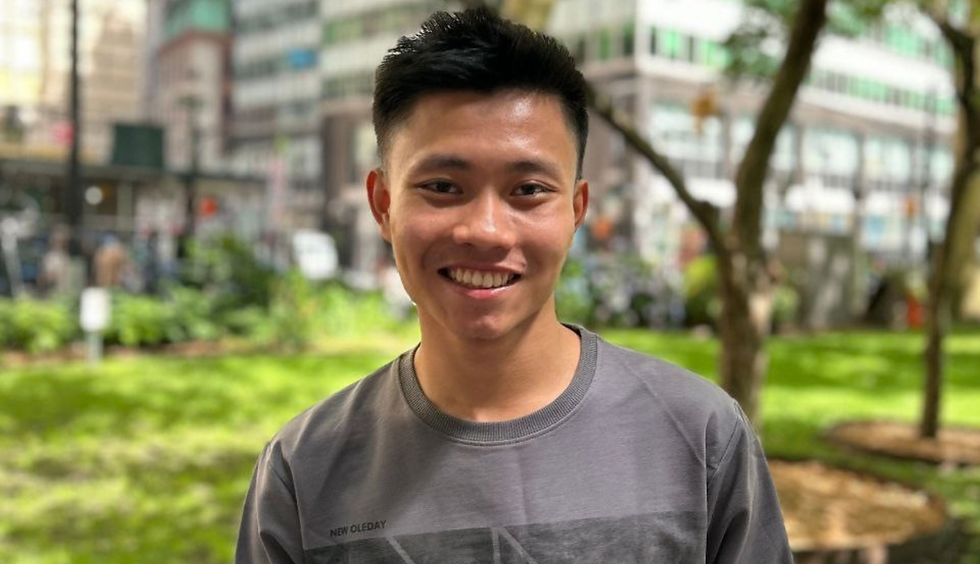
What happens when an education in philosophy, politics, and economics meets the world of FinTech?
For Kaung Myat Phyo (Kelvin), a Parami alumnus, studying PPE has shaped how he approaches problems in his early career at ThitsaWorks.
Kelvin graduated from Parami University in June 2026 with a BA in Philosophy, Politics, and Economics and joined ThitsaWorks later that month as a Program Associate in the Executive Office. He described his transition from Parami to ThitsaWorks as happening quite quickly.
“During my final year at Parami, I developed a new interest in FinTech, drawn to the growing intersection of technology and finance. That interest led me to ThitsaWorks.”
Bringing different perspectives to the workplace
Kelvin’s role involves working with senior management and teams across the company. His responsibilities include researching projects, preparing information, coordinating cross-functional work, reviewing and drafting documents, and supporting external engagements.
“What I like about the role is that I get exposed to very different sides of the company. I am still early in my career, so being able to observe how technical, business, operational, and management decisions come together has been a valuable learning experience.”
The role has also allowed him to connect academic learning with practical challenges in financial inclusion.
“It's a rewarding experience to work on actual financial inclusion problems and solutions which were once learned only in theory.”
Applying interdisciplinary thinking
For Kelvin, one of the most valuable things he gained from studying PPE was a way of approaching problems.
“Studying PPE constantly required me to look at an issue from different perspectives. A problem might have an economic dimension, a political dimension, an institutional dimension, and a human dimension at the same time.”
He sees this approach as useful in the workplace, where problems often involve multiple considerations.
“That kind of thinking is surprisingly useful in the workplace, because real problems rarely arrive neatly labeled as an ‘economics problem’ or a ‘technology problem.’”
His connection with ThitsaWorks also began while he was a student, through a Parami guest speaker session featuring the company’s CEO and Parami’s first Virtual Career Fair, where ThitsaWorks participated as a potential employer.
“The connection Parami has managed to build with potential employers like ThitsaWorks was important because it created a pathway for students and recent graduates to learn about opportunities that we might not otherwise have encountered.”
Staying adaptable
Kelvin also sees adaptability as an important skill for students entering the professional world.
“I can't speak for the experience of other students, but for me, Parami really trained me to be an adaptable person. Adaptability is increasingly important in today's rapidly changing world, which, I believe, Darwin would call ‘the survival of the most adaptable.’”
For him, adaptability can complement having a specific area of focus.
“Parami and its focus on liberal arts and interdisciplinarity can help you to become well-rounded and highly adaptable. I don't mean you should become a complete generalist—no, please have some specific focus or preferred skill set. But it never hurts to be adaptable at the same time.”
Kelvin’s transition from PPE to FinTech shows how interdisciplinary thinking can continue beyond the classroom, as he applies different perspectives to his work while developing his professional focus.


Comments